
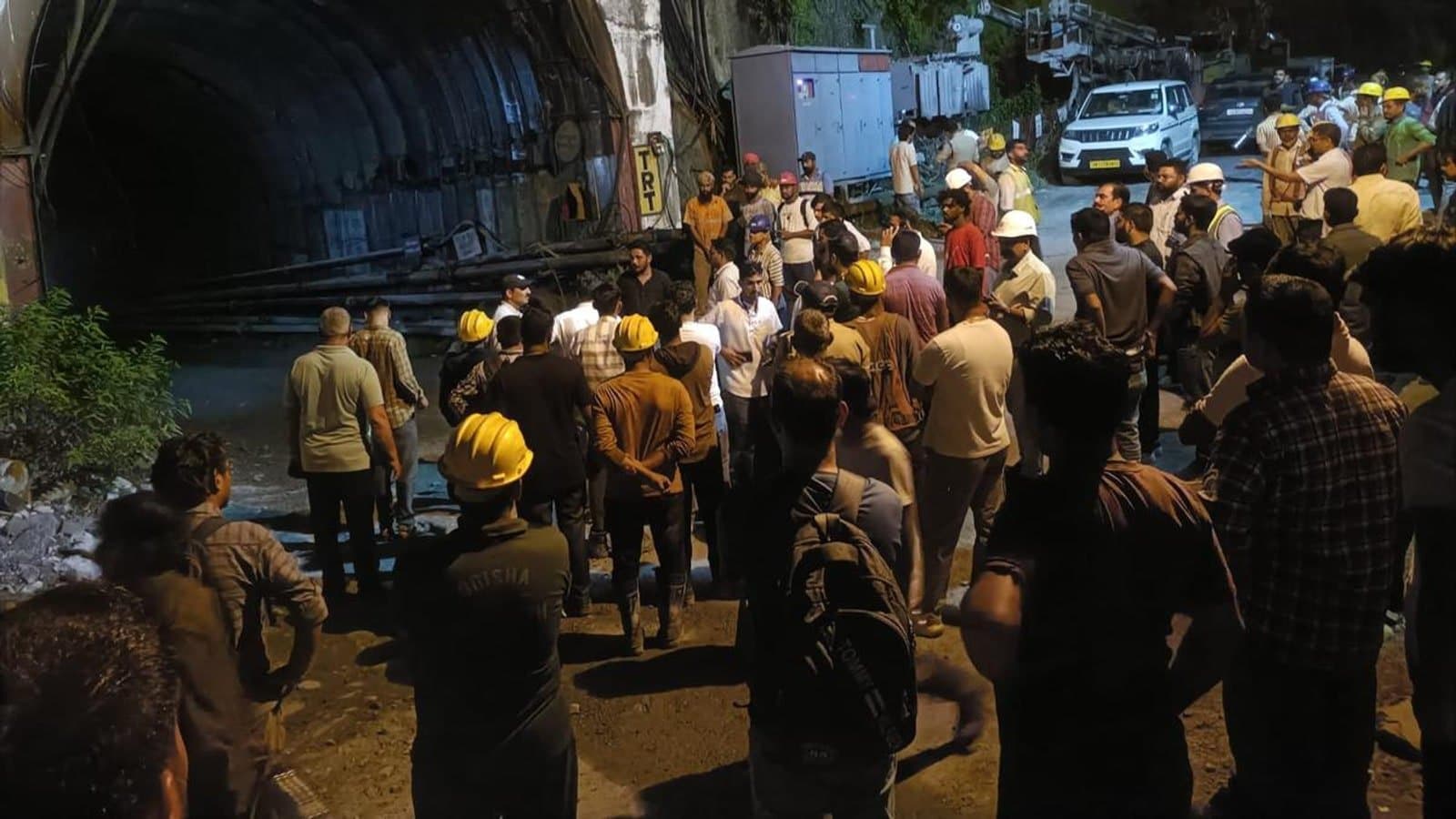
Water and debris burst into an under construction tunnel at the Vishnugad Pipalkoti hydroelectric project in Chamoli district on Thursday evening, trapping workers on the shift. The project belongs to THDC India and the tunnel is being built by Hindustan Construction Company. Reports put the number inside at eighteen or nineteen, with sixteen brought out and a small number still unaccounted for as this was written. Accounts of the injuries differ, some describing them as minor with the men stable and others reporting two in a more serious condition being stabilised. These figures are from a rescue still in progress and are likely to change.
Police, the state disaster response force, a national disaster response team from Rudraprayag, the Indo Tibetan Border Police, the Central Industrial Security Force and Army units are at the site. Chief Minister Pushkar Singh Dhami said the priority was to bring out everyone inside and that the operation was being run on a war footing. The Chief Secretary Anand Vardhan, the district magistrate Gaurav Kumar and the disaster management secretary Vinod Kumar Suman are among the officials involved.
The reflex comparison is Silkyara, where 41 men spent seventeen days behind a collapsed section of the Silkyara Barkot tunnel in Uttarkashi in November 2023 before being brought out through a passage of welded pipes. That comparison is worth resisting, because the two failures are not the same and the difference explains why most of this shift walked out within hours.
At Silkyara a section of roof came down and sealed the men in behind sixty metres of rock. The blockage was static. It was survivable precisely because it was stable, which allowed rescuers to keep the trapped men alive through a pipe while they worked for more than two weeks on a way through. What happened at Pipalkoti was an inrush, water and loosened material breaking in from a cavity partway along the bore. An inrush does not seal a tunnel so much as fill it, and it moves. It gives the people inside a short window in which the way out is still open, which is why sixteen were able to use it, and it closes that window fast.
This is the characteristic hazard of driving tunnels through young Himalayan rock, and it is harder to engineer against than a roof fall. The rock here is fractured and holds water under pressure, and a heading can hole into a charged zone with little warning. Probe drilling ahead of the face is the standard defence, and whether it was being done, and what it showed, is the first question any inquiry into this will have to put.
It is also the second time water has surged into a hydro tunnel in this district in recent memory. In February 2021 a mass of rock and ice came down in the Rishiganga valley and swept into the tunnel of another hydro project in Chamoli, and a large number of those who died were workers who had been inside it. The projects are different and the trigger then was above ground rather than in the rock, but the pattern is the same: a valley being tunnelled for power, water arriving faster than anyone underground can move, and the people underground being contract labour on a shift.
None of that is an argument against the rescue, which by the early figures has gone quickly and well, and the men brought out owe that to a response that was on site fast. It is an argument about what happens after the last worker is accounted for. Silkyara produced a great deal of attention and a promise of safety audits across tunnelling projects in the state. Whether Pipalkoti had escape provisions, whether probe drilling was in use, and whether the audits after 2023 reached this bore are the questions worth returning to in a month, when the cameras have gone.