
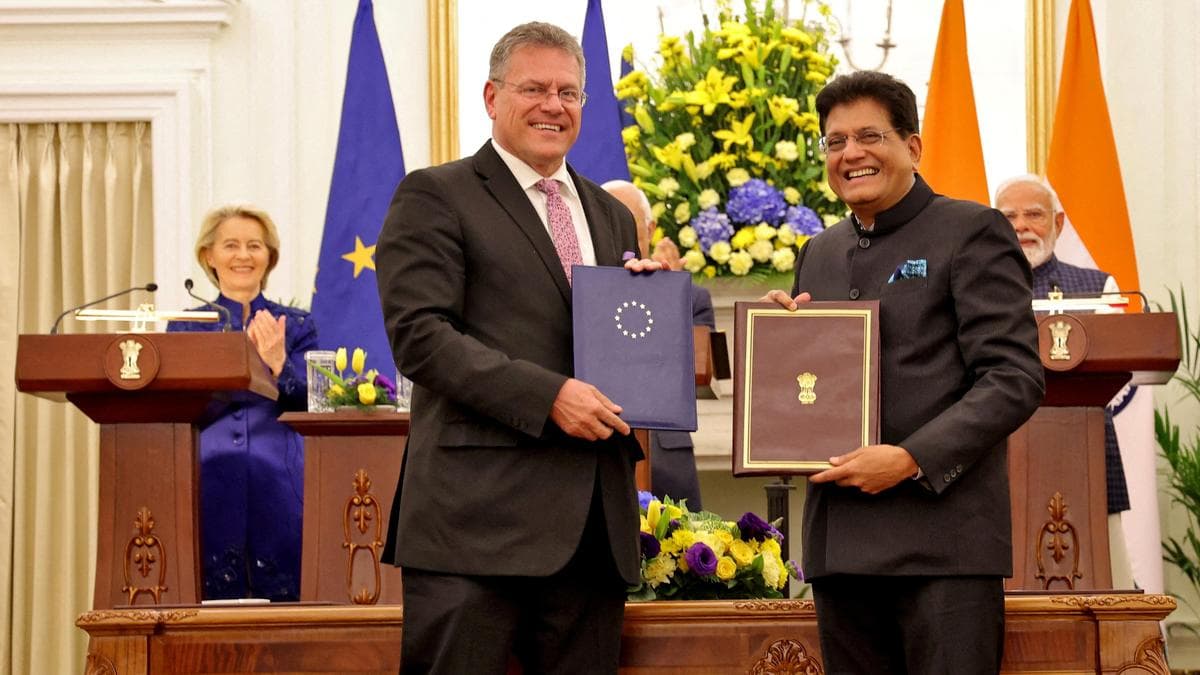
India and the European Union have set December 16 as the date for the formal signing of their free trade agreement, moving the landmark pact a step closer to entering into force after negotiations that stretched across nearly two decades in fits and starts.
The deal was politically concluded on January 27 at the 16th India-EU Summit in New Delhi, with European Commission President Ursula von der Leyen, European Council President Antonio Costa and Prime Minister Narendra Modi presiding over the announcement. That conclusion followed a negotiating process that first launched in 2007, went dormant in 2013, and was revived in 2022, culminating in a 14th and final formal round held in October 2025.
Since January, the two sides have been working through legal scrubbing of the text, translating and verifying the agreement to ensure consistency across its many provisions, a process India's Commerce and Industry Minister Piyush Goyal had earlier said both sides were aiming to complete within fifteen to twenty days. With that stage now behind them, the European Commission has referred the finalised text to the EU Council, which must authorise its signature before the December ceremony can go ahead.
EU Trade and Economic Security Commissioner Maros Sefcovic, who has held repeated rounds of talks with Goyal over the course of the negotiations, has stressed that the priority now is making sure businesses and citizens on both sides feel the benefits of the deal quickly once it takes effect. Even after signing, the agreement still requires the European Parliament's consent before it can be formally concluded and enter into force.
Officials have pointed to implementation beginning sometime between February and March 2027 as the current target, a timeline that would bring one of the most closely watched trade negotiations in recent memory, often described as the largest such deal either side has struck, into practical effect roughly a year after its political conclusion.