
India's nuclear stockpile stands at roughly 190 warheads as of the start of this year, up from 180 a year earlier, according to the latest Stockholm International Peace Research Institute yearbook, a modest but notable rise that comes alongside a more significant shift in how those weapons are held and deployed.
For the first time, the SIPRI assessment places a portion of India's arsenal, around 12 warheads, in the deployed category rather than storage, with the remaining 178 held in reserve. That change reflects a broader move toward operational readiness rather than simply stockpile growth, and marks a departure from the posture India has maintained since first testing nuclear weapons.
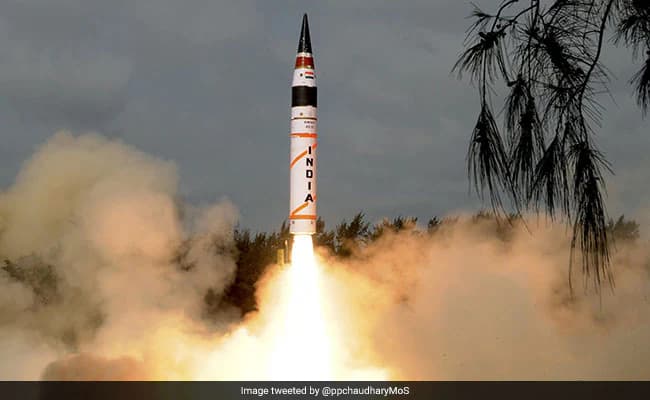
On the delivery side, the Agni-V stands as the centrepiece of India's land-based deterrent, a three-stage, solid-fuel, road-mobile missile capable of striking targets out to roughly 6,000 kilometres and demonstrated to carry up to three nuclear warheads on a single missile using multiple independently targetable re-entry vehicle technology. The first canistered version of the Agni-V is now believed to be operational, while the shorter range Agni-Prime is expected to join it within the next year or two. The older Agni-III, a two-stage rail-mobile missile with a range beyond 3,200 kilometres, continues to round out the intermediate tier of the arsenal.
India's sea-based leg has expanded just as fast. The nuclear-powered submarines INS Arihant and INS Arighaat each carry four missile tubes, while the newly commissioned INS Aridhaman, which entered service this April, carries eight, a capacity the forthcoming INS Arisudan is expected to match. Together with the land-based missile force, these submarines complete the triad of land, sea and air delivery options that underpins India's declared No First Use policy, under which it has committed not to be the one to begin a nuclear exchange.
Much of the recent expansion in range and payload points toward a shift in strategic orientation. Where India's earlier missile programme was shaped primarily around deterring Pakistan, the newer generation of Agni missiles carries ranges that line up more closely with targets across China, a country whose own nuclear arsenal is estimated to be more than three times the size of India's, a gap that continues to shape how New Delhi thinks about the scale and readiness of its own deterrent.