
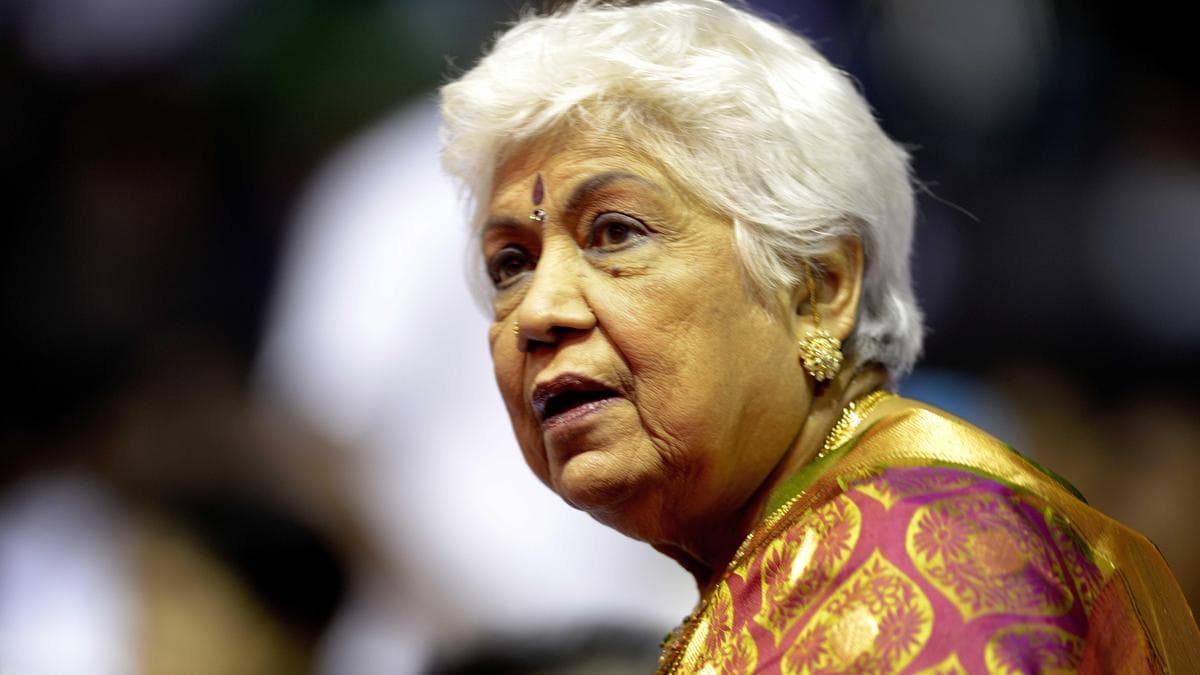
Sowcar Janaki, one of the most respected and versatile actresses of Tamil cinema, has died, according to The Hindu. Her passing marks the end of an era for an artist whose career spanned decades and helped define the golden age of Tamil film performances.
Janaki rose to prominence during a period when Tamil cinema was dominated by towering male stars, and she distinguished herself as one of the few actresses whose screen presence could stand shoulder to shoulder with the legendary Sivaji Ganesan. According to The Hindu, she starred opposite Ganesan in several acclaimed films, including Puthiya Paravai, Uyarntha Manithan and Mahakavi Kalidas, projects that remain touchstones in the history of Tamil filmmaking.
What set Janaki apart, as The Hindu's tribute notes, was not merely the frequency with which she appeared alongside the industry's biggest names but the depth and range she brought to her craft. Her ability to inhabit majestic, commanding roles while also bringing subtlety and finesse to quieter, more intimate scenes earned her a reputation as a true actor's actor, someone whose work rewarded close attention rather than relying on star power alone.
Her command over song sequences, a crucial element of Tamil cinema during her era, further cemented her standing among audiences. Combined with a distinctive body language and a precise, evocative delivery of dialogue, Janaki's performances often elevated the films she appeared in, turning supporting or co-lead roles into memorable cinematic moments that fans still discuss decades later.
The actress belonged to a generation of performers who helped shape the aesthetic and narrative sensibilities of South Indian cinema at a time when the industry was rapidly professionalising and expanding its reach across Tamil Nadu and beyond. Working alongside Sivaji Ganesan, one of the most celebrated actors in Indian film history, was itself a mark of prestige, and Janaki's ability to hold her own in such collaborations speaks to the trust directors and producers placed in her talent.
Her filmography reflects a career built on versatility rather than typecasting. Unlike many contemporaries who were often confined to narrow archetypes, Janaki moved comfortably between roles that demanded regal poise and those that required emotional vulnerability, a range that made her a favourite among directors seeking nuanced performances for complex characters.
Tributes to Janaki are expected to pour in from across the Tamil film fraternity, given her long-standing association with an era widely regarded as a creative high point for the industry. Contemporary actors, directors and film historians have long cited performers of her generation as foundational influences on the craft of screen acting in Tamil cinema.
Her death comes at a time when the Tamil film industry has increasingly been revisiting and celebrating the contributions of its pioneering artists, with retrospectives, restorations of classic films and renewed scholarly interest in the performers who built the industry's early reputation. Janaki's body of work is likely to feature prominently in such conversations in the coming months.
Beyond her individual performances, Janaki's career also offers a window into the broader evolution of women's roles in Tamil cinema during the mid-twentieth century, a period when actresses were beginning to secure more substantial, character-driven parts rather than purely decorative ones. Her success in films opposite Sivaji Ganesan helped demonstrate that female leads could carry significant narrative and emotional weight in major productions.
As the Tamil film community and audiences across India mourn her passing, Janaki's legacy endures through the films she left behind, works that continue to be studied, screened and cherished by new generations of cinephiles. Her contribution to Tamil cinema, as chronicled by The Hindu, remains a benchmark for the kind of disciplined, expressive artistry that defined a formative chapter in Indian film history.