
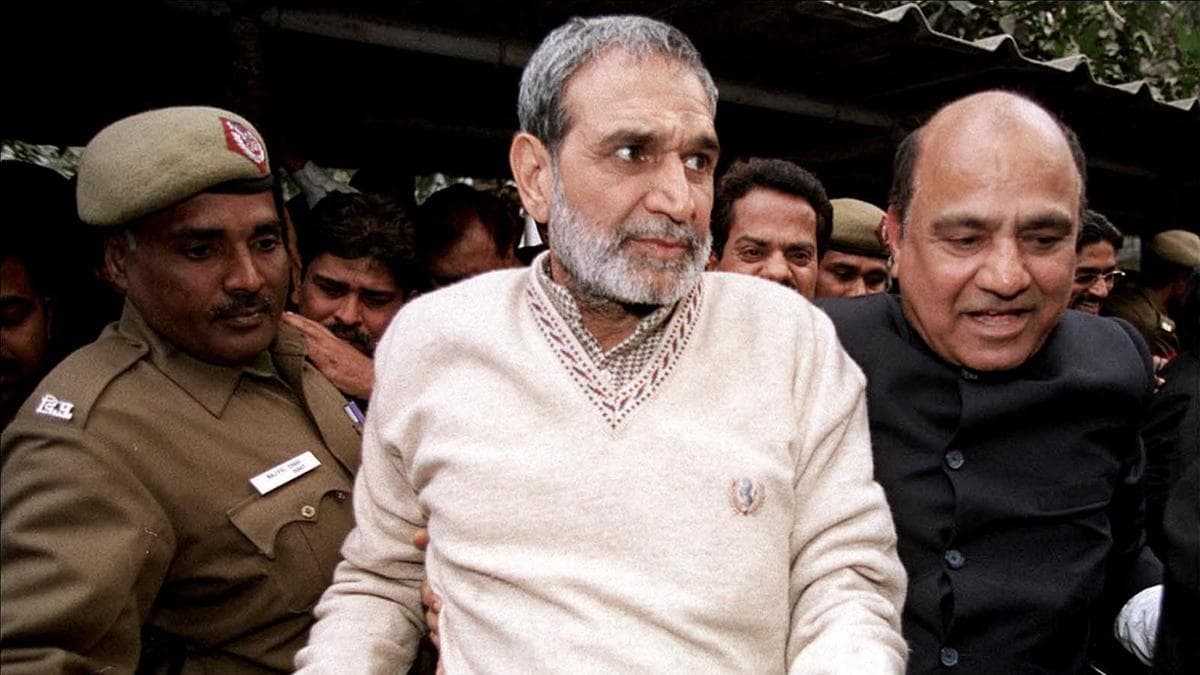
Sajjan Kumar, the former Congress Member of Parliament whose name became inextricably linked with the 1984 anti-Sikh riots, has died, according to The Hindu. He spent his final years in prison, having been convicted in more than one case connected to the violence that swept Delhi and other parts of the country following the assassination of then Prime Minister Indira Gandhi.
The riots of November 1984 remain one of the darkest chapters in independent India's history. Over the course of a few days, mobs targeted Sikh families across Delhi and elsewhere, killing thousands and displacing many more. For decades afterward, the question of accountability hung over the political establishment, with survivors and civil society groups demanding that those who organised or incited the violence be brought to justice.
Sajjan Kumar was among the most prominent political figures accused of playing a role in orchestrating attacks on Sikh residents in his Delhi constituency during that period. As The Hindu notes, the case against him unfolded over decades, marked by repeated investigations, multiple official committees, and a long, often frustrating journey through the Indian judicial system.
The path to holding Kumar accountable was neither swift nor straightforward. Successive commissions and special investigation teams examined the events of 1984 over the years, with findings that at times implicated him and at other times fell short of securing convictions. This pattern reflected the broader difficulty India has faced in prosecuting mass communal violence, where evidence can be difficult to establish decades after the fact and witnesses often face intimidation or reluctance to testify.
According to The Hindu, Kumar was ultimately convicted twice in cases tied to the riots, a rare instance of a politician of his stature being held legally responsible for the 1984 violence. However, he was also acquitted in at least one other related case, underscoring how uneven and prolonged the pursuit of justice for 1984 victims has been across different legal proceedings.
His eventual convictions were seen by many Sikh community members and riot survivors as a long-delayed but significant moment of accountability. For years, activists and victims' families had argued that political protection allowed many alleged perpetrators of the violence to evade serious consequences, even as the human toll of the riots remained a searing memory for the community.
Kumar's political career, once rooted in Delhi's Congress establishment, was ultimately overshadowed by the criminal proceedings that followed him for much of his later life. His case became something of a symbol in India's ongoing reckoning with the 1984 violence, cited repeatedly in public discourse whenever the question of justice for riot victims resurfaced.
The Congress party, under whose banner Kumar once served as an MP, had distanced itself from him over the years as the legal case against him progressed and as the party sought to address the political liability the riots represented for it, particularly in dealings with the Sikh electorate.
Kumar spent his final years incarcerated, a fact The Hindu's report emphasises as central to understanding the arc of his post-political life. His death closes a chapter in a case that had, for four decades, symbolised both the difficulty and the eventual possibility of prosecuting powerful political figures for communal violence.
The news of his death is likely to reignite discussion in Delhi and beyond about the broader legacy of the 1984 riots, the adequacy of the justice delivered in the intervening decades, and the cases that remain unresolved or ended in acquittals. For survivors and their families, Kumar's death marks not necessarily closure, but another moment to reflect on a tragedy whose full accounting remains, in the eyes of many, still incomplete.