
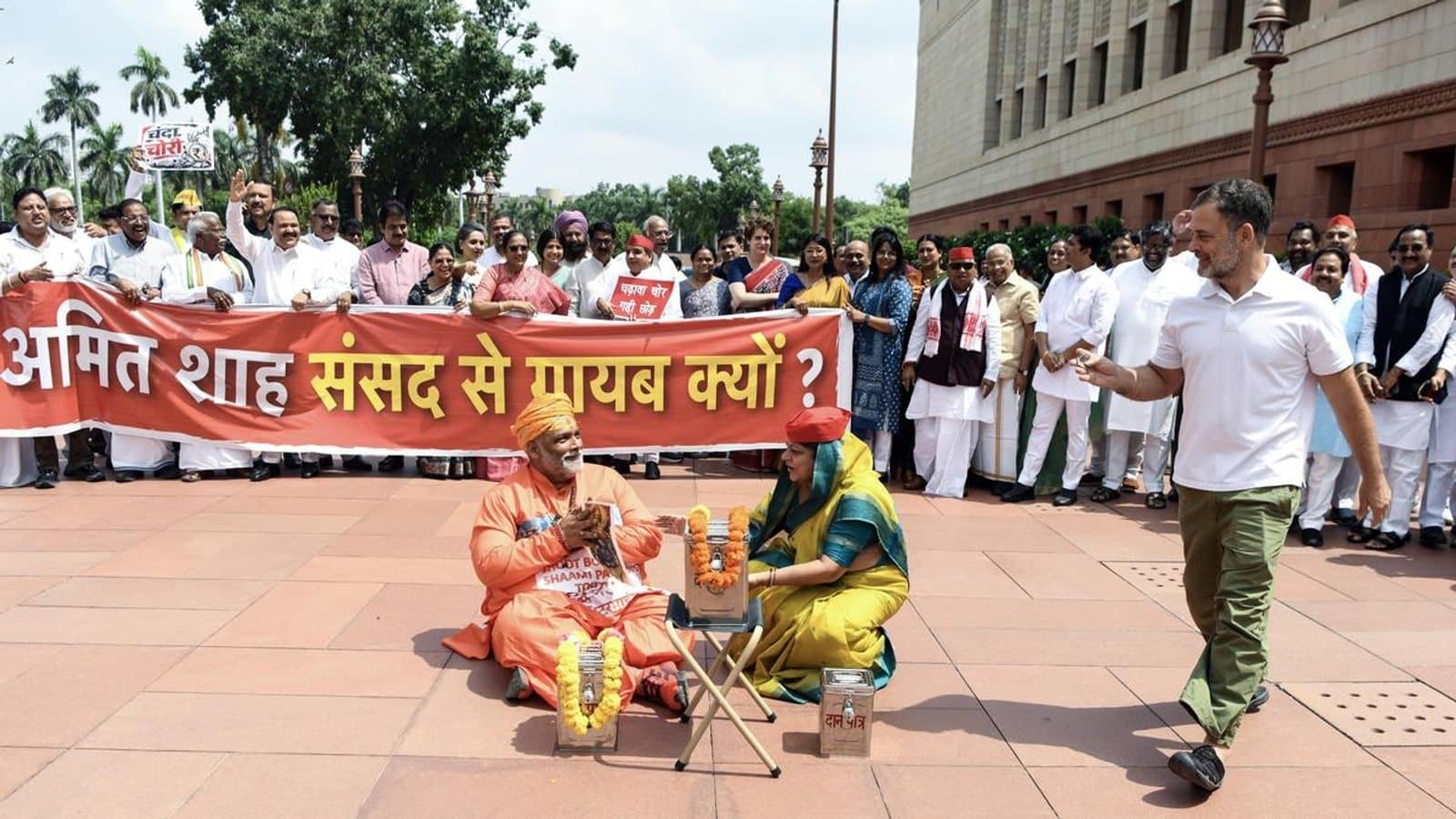
The Varanasi police registered a First Information Report on Saturday against the Leader of the Opposition in the Lok Sabha, Rahul Gandhi, and the MPs Rajesh Ranjan, known as Pappu Yadav, and Awadhesh Prasad. The complaint concerns a skit the three took part in on the Parliament premises in Delhi about alleged embezzlement of donations at the Ram temple in Ayodhya.
The performance took place on Friday at the Makar Dwar of the Parliament complex during the monsoon session. Yadav, wearing a saffron outfit, sat with a collection box while Gandhi appeared to put money into it, which Yadav then moved into his own pocket. The point being made was blunt and it was made in about fifteen seconds, which is what street theatre is for.
The FIR was filed at Kotwali police station at around 2 in the afternoon on a complaint by Jagadguru Balak Das, head of the Patalpuri Math, and other seers. It names all three MPs under four provisions of the Bharatiya Nyaya Sanhita: section 196 on promoting enmity between groups, section 299 on deliberate and malicious acts intended to outrage religious feelings, section 302 on words or gestures meant to wound religious feelings, and section 3(5) on acts committed by several people with shared intention. The complaint says the seer community was deeply hurt by what it called an insult to saffron, a colour it holds sacred in the Sanatana tradition. Separately, BJP leaders including the Lok Sabha MP Bansuri Swaraj petitioned the Parliament Street police station in Delhi seeking action over the same skit.
Two things about the filing are worth noting before anyone argues about the politics. The first is jurisdiction. The performance happened in Delhi and the case has been registered in Varanasi, which is lawful where an offence is said to have had effect in a place, but it does mean three sitting MPs must now answer in a district several hundred kilometres from where they were standing. The second is what the sections chosen actually require. Provisions on outraging religious feelings turn on deliberate and malicious intent, and a court would have to find that the object of the skit was the faith rather than the handling of the money. A performance aimed at trustees is not automatically a performance aimed at a religion, and that distinction is the whole case.
The Uttar Pradesh Congress president, Ajay Rai, called the FIR a blatant misuse of government machinery by people linked to the BJP and the Vishva Hindu Parishad, and asked why no case had been registered over the Ayodhya allegations themselves. He named Champat Rai, formerly general secretary of the Shri Ram Janmabhoomi Teerth Kshetra, and said Congress workers would petition the local police on 2 August seeking an FIR in that matter.
That is the part of this worth holding on to, whatever one makes of the skit or of those performing it. Two separate questions are now in play and only one of them has moved. Whether a piece of theatre outside Parliament crossed into an offence is a question the courts will settle. Whether donations given to a temple were misapplied is a question of accounts, and it is answerable by an audit rather than by an argument about who was wearing saffron. The FIR does not touch it.
The wider pattern is familiar and it is not the property of any one party. A charge gets made in a form designed to travel, the response arrives as a criminal complaint rather than a rebuttal, and the original allegation slips out of view while everyone argues about the manner in which it was raised. It works because it usually works. The test here is narrow and quite public: whether an audit of the temple donations is produced with the same speed as the FIR was.